Supporting Our Trainee Teachers in the Age of AI
- Nov 20, 2025
- 6 min read

I've been wondering lately about the conversations happening in university corridors and staff rooms across the country. Picture this: it's week three of term, and a PGCE student sits hunched over their laptop at 11 PM, eyes glazed from another day of observations, assignments, and trying to decode the mysterious art of classroom management. They need a lesson plan for tomorrow's Year 9 Geography class on river formation, and they're absolutely exhausted.
So they open ChatGPT.
And here's the aforementioned wondering: are we supporting our ECTs to become the best teachers they can be... with AI?
What's the sitch?
I'm three weeks into a six week course on Thinking with AI with a cohort of PGCE and SCITT trainees from School of Education - Durham University and Dulwich College. We've been spending some time exploring thoughtful use of AI in the classroom, but this week I thought I'd take it a step back. I asked them about their own relationship with AI as beginning teachers.
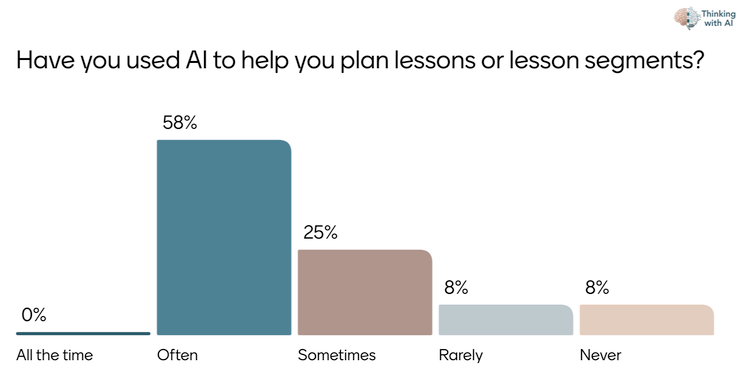
When I asked how many of them used AI to plan lessons or lesson segments, the results stopped me in my tracks: 58% said often, and 25% said sometimes. That's over 80% of trainee teachers regularly using AI for lesson planning, and most of them haven't had any formal training on how to do this effectively.
The thing is, this makes complete sense when you consider what they're dealing with. Studies consistently show that workload is the primary factor impacting teacher wellbeing, and research tells us that the induction year is particularly significant in teacher attrition. Beginning teachers face enormous pressures around organisation, assessment, working with parents, and understanding individual students - all whilst trying to master the fundamental craft of teaching.
The DfE has actually made recommendations about reducing workload for trainees because they recognise how overwhelming this period can be. And now we've thrown AI into the mix.
What makes this particularly interesting is the nature of this latest cohort of teacher trainees. They're a fascinating mix, aren't they? Yes, there are the usual career changers and mature students, but if you're going into teacher training straight from university, you're coming out of having access to AI throughout a huge chunk of your degree journey. You've been able to use AI tools pretty much however you wanted, and you've also navigated your exam years during the pandemic and subsequent shifts to online and hybrid learning. This cohort has already developed their own relationships with technology in ways we're still trying to understand.
The Risk We're Running
During this week's training session, we looked at example lesson prompts where imaginary groups of teachers had fed different requests into AI. The trainees had to discuss which prompts were offloading their thinking and which weren't. The conversations that emerged were brilliant - they absolutely understood the risks.

They know that when you're drowning in the demands of teacher training, it's tempting to hand over the cognitive load to an AI. They recognise that this could undermine their development of crucial pedagogical knowledge. They're worried about becoming dependent on tools that might not serve their students well.
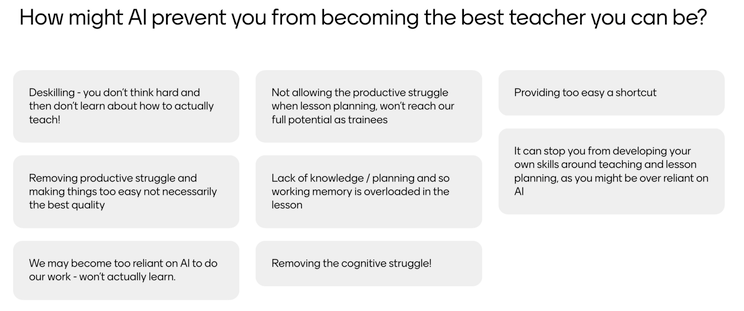
And honestly, they should be worried. Good use of AI relies on having robust subject and pedagogical knowledge to begin with. When I use AI to help with a history lesson plan, I can judge the suggestions, spot the gaps, and know what needs adapting based on my understanding of common misconceptions and effective teaching strategies. But a trainee teacher doesn't have that expertise yet - that's precisely what they're there to develop.
I was doing lesson observations yesterday, and it struck me how one experienced teacher demonstrated exactly what I mean. She had such clear understanding of common misunderstandings in her subject that when students inevitably gave those familiar incorrect responses, she was ready. She knew what to listen for and how to respond. A beginning teacher simply doesn't have that pedagogical content knowledge yet - they don't know what misconceptions to anticipate or how different explanations might land with different students.
So then the question becomes: if we don't teach trainee teachers how to use AI thoughtfully, are we setting them up to be less effective than they could be?
I think the answer is yes, and here's why. We need to assume that many trainees are already using AI anyway - my informal survey certainly suggests this, and whilst it might be slightly skewed because participants had opted into additional AI training, I suspect the reality is that AI use is widespread whether we acknowledge it or not.
So instead of ignoring this reality, what if we taught them how to engage with these tools in ways that actually support their development as teachers?
A Framework for Growth
At the risk of sounding like an LLM with a classic 'it's not X, it's Y' type phrase, what all of this is making me realise is that once again the conversation and thinking isn't really about AI at all. It's about supporting our trainee teachers to develop professional judgement and pedagogical expertise whilst acknowledging the tools they're already using.
We have an opportunity here to model the kind of thoughtful, reflective practice we want to see in schools. If we ignore AI use or treat it as somehow separate from 'real' teaching, we miss the chance to help beginning teachers develop the critical thinking skills they'll need throughout their careers. Or, in other words: what would it look like if every teacher training programme included explicit guidance on using AI thoughtfully? What if we treated this as an essential professional skill rather than an optional add-on?
Honestly, I think we owe it to our trainee teachers - and ultimately to their future students - to engage with this idea seriously. They're navigating unprecedented challenges and using tools we're still figuring out ourselves. The least we can do is think alongside them about how to do this well.
So here was my sort-of-solution. I've been working with an adapted version of the 'gap-grasp-guide-grow' framework that I shared in the Thinking with AI book (which of course you can buy here!), but tailored specifically for trainee teachers or ECTs.
The original framework helps students use AI without undermining their learning. This adapted version is designed to help beginning teachers use AI in ways that enhance rather than erode their professional development. So here it is. And, for funsies, here's a Google doc version that you can copy for yourself. The students seemed to like it as a framework, and as we iterated on prompts together I could see them starting to understand the value of a framework like this. I'd love to hear your thoughts, too!
GRASP-GAP-GUIDE-GROW: An AI Use Framework for Trainee Teachers
GRASP: What do I currently know?
What subject content do I understand?
What pedagogical strategies do I know for this topic?
What do I know about my students?
What's my current plan (even if incomplete)?
GAP: Where exactly is my planning incomplete?
What pedagogical strategies am I unsure about?
Where do I need more examples or activities?
What differentiation am I struggling with?
What timing/pacing issues do I have?
GUIDE: How can AI be my planning partner?
Craft specific prompts that keep YOU in charge, like the following examples:
"I'm planning to teach [X] using [Y strategy]. Can you suggest 2-3 variations of this approach?"
"I've identified these common misconceptions [list]. Help me design formative assessment questions to check for them"
"Here's my lesson structure [paste]. What's missing from a cognitive load perspective?"
GROW: How can I deepen and verify my planning?
Can I explain every pedagogical choice I've made?
Can I modify this lesson without AI?
Do I understand WHY this approach works?
Can I teach this to my mentor teacher?


Comments